

Yi Yi Ren Tang (薏苡仁汤) — Coix Decoction
On this page
Overview
Yi Yi Ren Tang — the “Coix Decoction” — is a classical formula for Wind-Damp-Cold Bi syndrome (obstruction syndrome of the joints) where Damp is the dominant pathogenic factor. The chief herb Yi Yi Ren (coix seed) drains Damp from the muscles and joints; the supporting herbs add wind-dispersing (Ma Huang, Gui Zhi), Damp-drying (Cang Zhu), Blood-moving (Dang Gui, Chuan Xiong) and pain-relieving actions.
It is one of the most widely used classical formulas for arthritis with prominent swelling, joint heaviness and stiffness aggravated by damp weather.
I prescribe Yi Yi Ren Tang as part of bespoke herbal formulas from pharmaceutical-grade granules sourced from Sun Ten in Taiwan.
TCM pattern
Yi Yi Ren Tang is prescribed for Wind-Damp-Cold Bi syndrome with prominent Damp:
- Joint pain with heaviness
- Joint swelling
- Stiffness, particularly in the morning
- Worse with damp and cold weather
- Better with warmth and movement
- Pain that moves between joints
- Body heaviness
- Tongue — pale or slightly purplish, white greasy coat
- Pulse — floating, slow, slippery
Key herbs
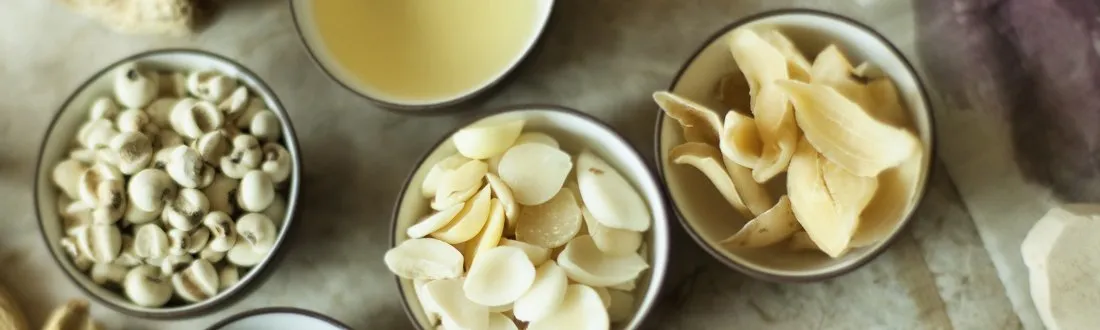
- Yi Yi Ren (coix seed, Coix lacryma-jobi, 2.4-6g) — chief; drains Damp from muscles and joints
- Cang Zhu (Atractylodes lancea, 3-9g) — dries Damp
- Ma Huang (small dose, 2.4-6g) — releases the surface and disperses Wind-Cold
- Gui Zhi (Ram. Cinnamomi, 2.4-6g) — warms the channels
- Dang Gui (Rx. Angelicae Sinensis, 4.5-9g) — nourishes and moves Blood
- Chuan Xiong — moves Blood and Qi
- Sheng Jiang, Gan Cao (Rx. Glycyrrhizae Preparata, 4.5-6g) — harmonise
Formula actions
- Disperses Wind-Damp-Cold from the channels
- Drains Damp
- Warms the channels
- Moves Blood and relieves pain
Conditions treated
- Rheumatoid arthritis with damp-cold pattern — see rheumatoid arthritis[14]
- Osteoarthritis with prominent swelling and morning stiffness
- Reactive arthritis
- Polymyalgia rheumatica in cold-damp pattern
- Fibromyalgia with cold-damp pattern — see fibromyalgia
- Chronic muscle and joint stiffness aggravated by damp weather
- Frozen shoulder with cold-damp pattern — see frozen shoulder
- Sciatica with cold-damp pattern — see sciatica
Cautions
Contains Ma Huang — not appropriate in pregnancy, hypertension[19], hyperthyroidism[6], cardiac arrhythmias or with stimulants. Always declare to your medical team.
Not appropriate for hot-pattern arthritis with red, hot, swollen joints.
Not appropriate for Yin-deficient joint pain.
Inflammatory arthritis needs rheumatology diagnosis and monitoring; herbs are an adjunct to disease-modifying treatment.
Always consult a qualified Chinese herbalist registered with the RCHM.
Prefer to be treated from home? Chinese herbal medicine online consultations are available throughout the UK and worldwide.
References
[6] Liu Y, Cheng L, Yan G, Gu J, Lyu Z, Ding J. Effectiveness and potential mechanism of Jiawei-Xiaoyao-San for hyperthyroidism: a systematic review. Front Endocrinol (Lausanne). 2023 Sep 18;14:1241962. https://doi.org/10.3389/fendo.2023.1241962. PMID: 37780612.
[14] Han R, Ren HC, Zhou S, Gu S, Gu YY, Sze DM, Chen MH. Conventional disease-modifying anti-rheumatic drugs combined with Chinese Herbal Medicines for rheumatoid arthritis: A systematic review and meta-analysis. J Tradit Complement Med. 2022 Jan 26;12(5):437-446. https://doi.org/10.1016/j.jtcme.2022.01.005. PMID: 36081815.
[19] Wang J, Xiong X, Liu W. Tianma Gouteng Yin as Adjunctive Treatment for Essential Hypertension: A Systematic Review of Randomized Controlled Trials. Evid Based Complement Alternat Med. 2013;2013:706125. https://doi.org/10.1155/2013/706125. PMID: 23710230.















